
Why Most Students Fail IELTS in 2026 – And How You Can Avoid Their Mistakes
Every year, millions of students sit for the IELTS exam with big dreams. Study abroad. Immigration. Better jobs. A new life. And every year, a painful truth repeats itself. Most of them fail to get the band score they need.
In 2026, IELTS is not harder in theory. The format is familiar. The rules are clear. Practice materials are everywhere. Yet failure rates remain high, and in some regions, they are rising.
Why?
The answer is uncomfortable. Most students are preparing in the wrong way. Not because they are lazy or weak in English, but because they follow advice that sounds good and feels safe, yet does not work in the real exam.
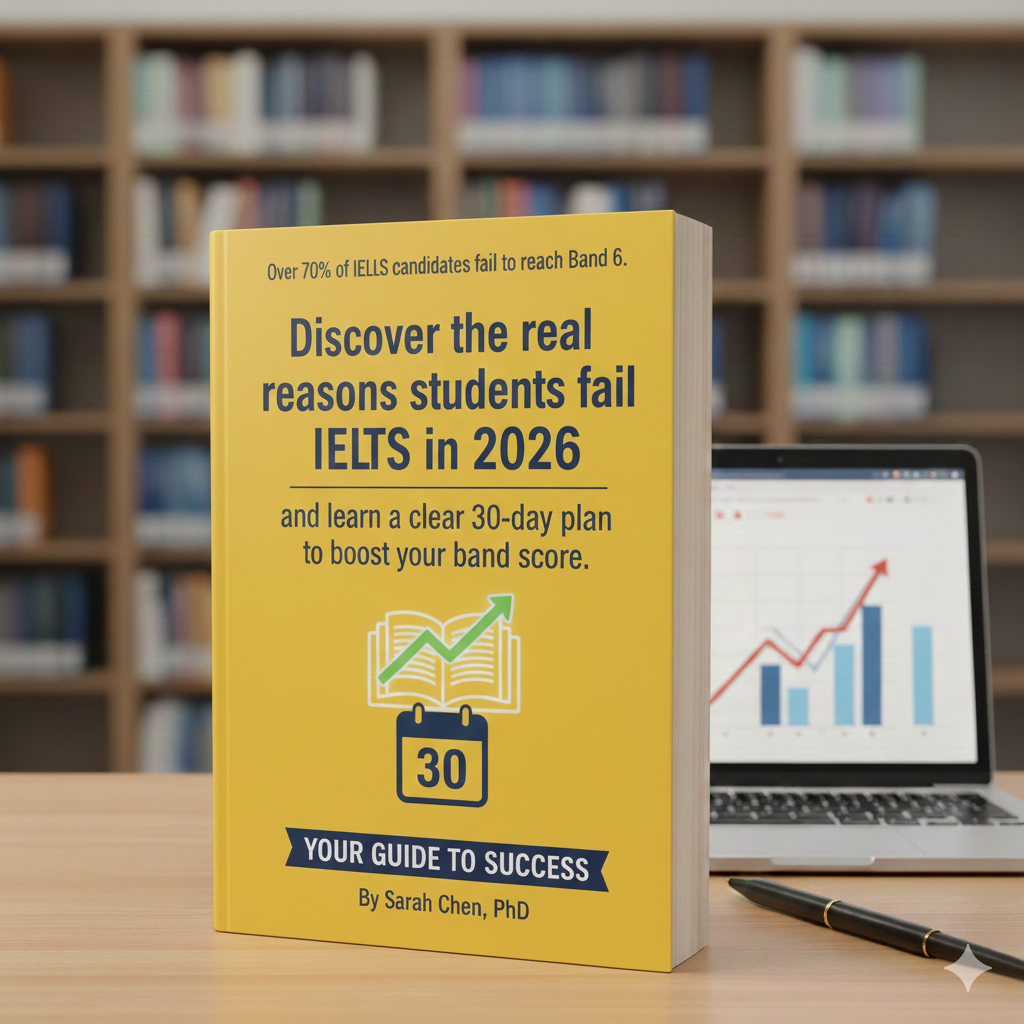
This article breaks down the real reasons students fail IELTS in 2026. Not the obvious ones. The real ones. More importantly, you will learn how smart students prepare differently and how you can avoid the same traps with a clear 30-day improvement plan.
If you are serious about your IELTS score, read this slowly. Take notes. And be honest with yourself.

The Shocking Reality – 70% of IELTS Candidates Score Below Band 6
Let us start with the numbers.
Across many test centers worldwide, nearly 70% of IELTS candidates score below Band 6. That means most students do not reach the minimum requirement for universities, professional registration, or migration programs.
This is not because IELTS is unfair. It is because the exam tests specific skills that many students never truly develop.
Band 6 is not advanced English. It is functional English. You are expected to understand main ideas, express opinions clearly, use a reasonable range of vocabulary, and avoid serious grammar errors. Yet even this level remains out of reach for most candidates.
Why?
Because many students confuse studying English with preparing for IELTS.
They memorize answers instead of building skills.
They watch tips instead of practicing under pressure.
They learn words instead of learning how to use them.
IELTS in 2026 rewards clarity, control, and consistency. It punishes shortcuts.
Let us look at the most common mistakes that hold students back year after year.
Mistake #1 – Memorizing Without Understanding
This is the most damaging mistake of all.
Students memorize essays for Writing Task 2.
They memorize cue card answers for Speaking.
They memorize “high band” vocabulary lists.
At first, it feels productive. You remember long answers. You feel confident. You believe you are ready.
Then the exam changes one detail, and everything collapses.
In 2026, IELTS examiners are trained to spot memorized content very quickly. Writing answers that sound unnatural or overly polished often receive lower scores, not higher ones. In Speaking, memorized responses lead to hesitation, flat delivery, and sudden confusion when follow-up questions appear.
The problem is not memory. The problem is dependency.
When you memorize without understanding, you cannot adapt. IELTS always tests your ability to respond, not repeat.
Smart preparation looks different.
Instead of memorizing essays, strong candidates learn how essays are built. They understand how to write an introduction, how to support one clear idea per paragraph, and how to give simple examples.
Instead of memorizing Speaking answers, they practice explaining ideas in their own words. They learn how to extend answers naturally and how to recover when they make mistakes.
Understanding gives you flexibility. Memorization takes it away.
Mistake #2 – Ignoring Real Exam Conditions
Many students practice IELTS in comfort.
They pause listening recordings.
They check answers while reading.
They take breaks during writing tasks.
This creates a false sense of ability.
In the real IELTS exam, there are no pauses. No second chances. No extra time. Your brain must perform under pressure.
In 2026, time pressure is one of the biggest reasons students lose marks, especially in Reading and Writing.
Students often say, “I can do this at home.”
But IELTS does not test what you can do at home.
It tests what you can do in that room, on that day, within that time.
Smart students simulate real conditions early.
They practice Listening without stopping the audio.
They complete Reading tests with strict timing.
They write essays by hand or on a computer exactly as in the test.
At first, their scores drop. That is normal. This is where real improvement begins.
Practicing under pressure trains your brain to stay calm, focused, and efficient. By exam day, the pressure feels familiar instead of overwhelming.
Mistake #3 – Weak Vocabulary Strategy
Vocabulary is one of the most misunderstood parts of IELTS.
Many students believe higher band scores require difficult words. This belief causes serious problems.
They use words they do not fully understand.
They misuse collocations.
They force advanced vocabulary into simple sentences.
Examiners do not reward big words. They reward appropriate words.
In 2026, IELTS marking criteria still focus on range, accuracy, and flexibility. Using simple words correctly is always better than using complex words incorrectly.
A weak vocabulary strategy looks like this:
- Learning long word lists without context
- Memorizing synonyms without knowing usage
- Avoiding repetition at all costs
A strong vocabulary strategy looks very different.
Smart students build vocabulary by topic. Education. Health. Technology. Environment. Work. They learn phrases, not just words. They pay attention to how words behave in sentences.
They accept some repetition. Native speakers repeat words too. IELTS examiners do not punish repetition when it sounds natural.
Most importantly, they practice using new words in Speaking and Writing. Passive vocabulary does not help your score. Active vocabulary does.
Mistake #4 – Poor Time Management
Time management is not about speed. It is about control.
Many students lose marks not because they do not know the answer, but because they run out of time.
In Reading, they spend too long on one passage.
In Writing Task 2, they write too much and leave Task 1 weak.
In Listening, they miss one answer and panic for the next five.
In 2026, IELTS remains a test of decision-making.
You must know when to move on.
You must know how much time each task deserves.
You must know when an answer is “good enough.”
Smart students practice timing as a skill, not an afterthought.
They allocate time clearly.
They use simple structures to save thinking time.
They train themselves to let go of difficult questions.
Perfection is not required in IELTS. Balance is.
Mistake #5 – No Feedback System
This mistake is silent but deadly.
Many students practice alone with no feedback. They do test after test, make the same mistakes, and never understand why their score does not improve.
Checking answers is not feedback.
Watching solution videos is not feedback.
Feedback tells you what you did wrong, why it was wrong, and how to fix it.
In Writing and Speaking especially, self-evaluation is unreliable. You cannot hear your own weaknesses clearly.
In 2026, smart students use feedback strategically.
They get their writing checked by trained teachers or reliable evaluation systems.
They record their speaking and analyze clarity, grammar, and structure.
They track repeated errors instead of chasing new tips.
Improvement comes from fixing patterns, not collecting information.
How Smart Students Prepare Differently
Smart IELTS students do not study more. They study better.
They focus on skills, not tricks.
They practice under pressure, not comfort.
They measure progress honestly.
They understand that IELTS is predictable when you understand the rules.
Here is what smart preparation usually includes:
Clear band goal with a deadline
Regular full-length practice tests
Focused improvement of weak areas
Simple, repeatable structures for Writing and Speaking
Consistent feedback and error tracking
They stop chasing Band 9 strategies and start mastering Band 6 and 7 requirements first.
Most importantly, they treat IELTS as a performance test, not a memory test.
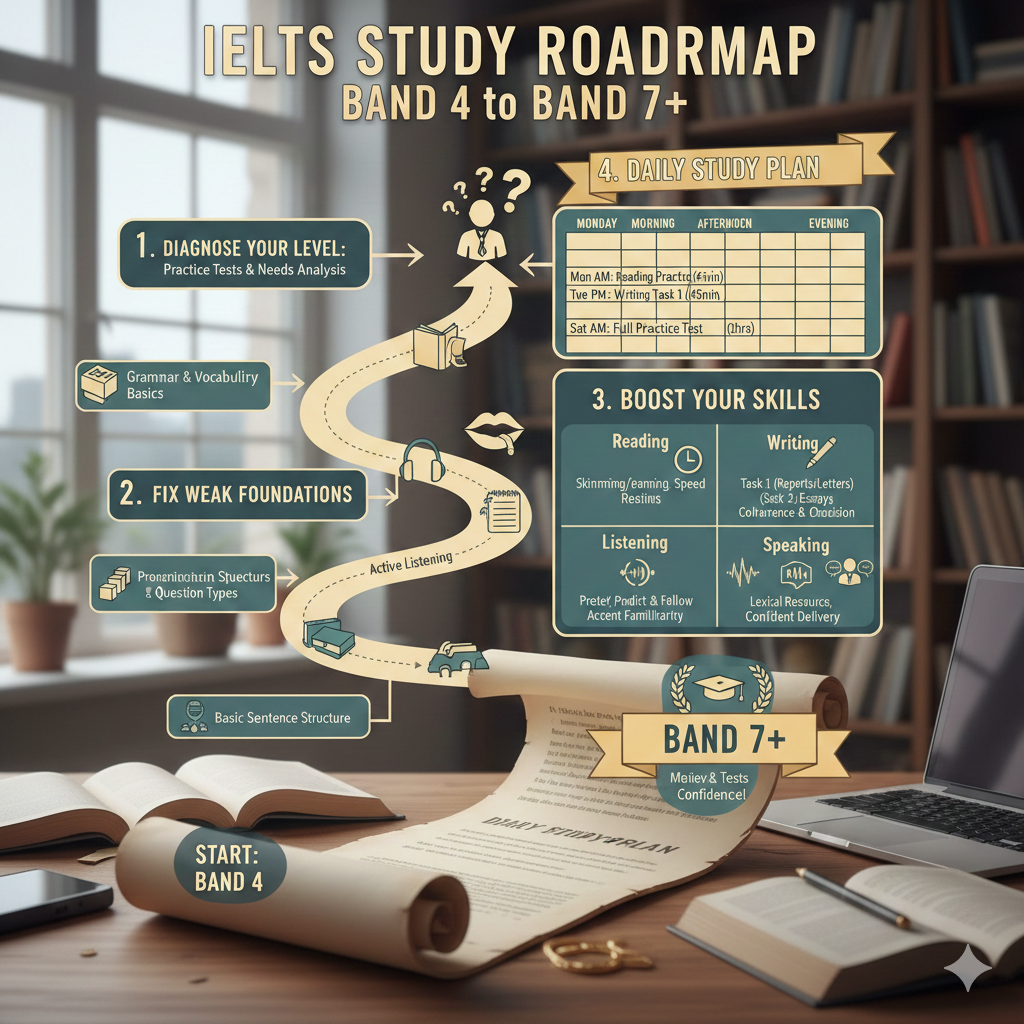
Your Personal 30-Day Band Improvement Plan
If your exam is one month away, this plan can help you improve by up to one band if followed seriously.
Week 1 – Diagnose and Reset
Take one full mock test under real conditions.
Identify your weakest module.
Stop memorizing templates and lists.
Focus this week on understanding band descriptors. Know exactly what examiners want.
Week 2 – Build Core Skills
Practice Writing Task 2 every alternate day. Focus on clarity, not length.
Practice Speaking daily for 20 minutes. Record yourself.
Learn vocabulary by topic and use it immediately.
This week is about building control.
Week 3 – Pressure Training
Take two full mock tests.
Practice Reading and Listening strictly on time.
Review mistakes deeply, not quickly.
This week trains your exam mindset.
Week 4 – Refinement and Confidence
Polish Writing introductions and conclusions.
Practice Speaking follow-up questions.
Reduce study hours slightly to avoid burnout.
The goal now is calm consistency, not last-minute tricks.
Final Thoughts
Most students fail IELTS in 2026 for the same reasons students failed in previous years. Not because they lack intelligence, but because they follow methods that do not match the exam.
IELTS rewards understanding, structure, and practice under pressure. When you align your preparation with these principles, your score becomes predictable.
Avoid memorization without meaning.
Avoid comfortable practice.
Avoid studying without feedback.
Do the hard things early. Do the simple things well.
Your band score is not a mystery. It is a result.
If you prepare smart, you can change it.