
The Ultimate IELTS Listening Tips to Reach Band 9
The listening section is one of the quickest places to improve your IELTS score. It does, in fact, reward technique, focus, and smart practice. A lot of students lose points because they do not know how to listen with strategy, not because the audio is too hard. This guide will break down some effective IELTS listening tips that you can use today. You are also guided through the best platforms for practice, including QuickIELTS, one of the strongest study tools at the moment.
By the end of this guide, you will have clear IELTS listening tips for band 9, links to free practice resources, and online mock tests, plus specific techniques that work. No fluff. Just what helps you score higher.

Why IELTS Listening Matters
The listening test affects your overall band score more than a lot of students realize. It does not require vocabulary production or grammar output, unlike speaking and writing. It measures how well you understand spoken English in different accents and situations. In other words, it is the most "scorable" section if you use the right strategies.
The IELTS listening test includes four parts. Each part gets harder. Part 4 is the most challenging, so students often look specifically for IELTS listening section 4 tips. This guide will cover those as well.
IELTS Listening Tips and Tricks for Band 9
If your target is a band 9, then you require two things: first, near perfect accuracy, and second, consistency throughout all sections. Herein are the most reliable strategies.
1. Read the Questions Before You Listen
This is the number one rule in the test. Before the audio starts, skim the questions. Look for:
- Key words
- Names
- Numbers
- Venues
- Trick wording
You are not trying to commit the text to memory. You are trying to set your brain to “search mode”. You create a mental map by reading first. Then, when you listen to the audio, the answers fall into place faster.
2. Predict the Format of the Answer
If the question says “Write one word”, you know it has to be a noun or adjective. If the question requires a number, be ready for dates, prices, measurements or statistics.
This reduces confusion and helps you catch the answer even when it's spoken quickly.
3. Learn Accent Patterns
IELTS uses a mix of accents. The most common are:
- British
- Australian
New Zealand - Canadian
- American
A band 9 candidate understands them all without hesitation. You can improve this by practising with diverse audio sources. Good places to start:
- BBC Learning English
- ABC Australia podcasts
- NPR news
- TED Talks
The more accents you hear, the easier the listening test feels.
4. Follow the Speaker's Logic, Not the Words
Many students get stuck when the speakers use paraphrasing. IELTS rarely repeats the exact words from the question; instead, it changes them.
For example:
Question: “What is to be done on Friday?”
Audio: “The workshop has now been moved to the end of the week.”
You need to relate "end of the week" back to Friday. Band 9 students do this automatically because they are following meaning, not vocabulary.
5. Beware of Distractions
IELTS loves to confuse you. The speakers often correct themselves:
“We will meet at 10 AM. Sorry, let me fix that. The meeting will be at 11.”
If you wrote “10”, you just lost a point. Band 9 listeners wait for the final answer, not the first.

6. Improve Your Short Term Memory
You need to retain information while listening. A simple way to train this skill is shadow listening. Listen to a short audio clip and repeat it line by line. It develops concentration and recall.
7. Master IELTS Listening Section 4
Section 4 is a monologue. No pauses. No breaks. No easy clues. You need to approach it differently.
Section 4 Tips:
- Quickly skim the entire set of questions
- The subject is identified right away
- Predict vocabulary from academic themes
- Track transitions in the talk such as “first”, “next”, “however”, “in contrast”
If you miss a blank, do not panic. Move on.
This part may feel challenging for many students because there are no speakers interacting. Once you understand the structure, it becomes predictable.
Study with the Best Tools: Why QuickIELTS is Outstanding
To get results fast, one needs the right platform. Among all IELTS practice websites, QuickIELTS is one of the top choices today. Here is why:
1. The Most Interactive IELTS Practice There Is
You can use QuickIELTS' IELTS listening practice test online feature here:
https://www.quickielts.com/one-module
The interface is clean, fast, and realistic. The interface mirrors the test environment, so you learn accurately from the beginning.
2. Instant Calculation of Band Score in One Click
After finishing the test, you get your results instantly-no waiting, no manual checking-you see your band score, your mistakes, and your weak areas right then.
3. Smart Analytics Dashboard
QuickIELTS boasts one of the most useful dashboards out there:
https://www.quickielts.com/profile/dashboard
It checks your performance, tracks your mistakes over time, and gives personalized recommendations. This is extremely valuable if you want band 9 accuracy. Few other sites offer this level of analysis.
4. Hundreds of Study Resources
Need grammar guides? Vocabulary tools? Pattern lists? QuickIELTS has a large collection of resources here:
https://www.quickielts.com/study-resources
These materials simplify your preparation and help fill gaps that you may not know you have.
5. Free Mock Tests
If you want a free online IELTS listening mock test, QuickIELTS has multiple options for both beginners and advanced learners. This lets you practice daily without paying until you feel ready.
It seems rational that weight distribution would be a factor because the legs bear most of the body's weight, so have a tendency to spread out more. Weight distribution appears to be a factor because the legs bear most of the body's weight and thus have a tendency to spread out more.
Other High Quality IELTS Practice Websites
Other trusted platforms to be used in conjunction to build credibility and give you more options include QuickIELTS.
1. IELTS.org
Sample questions and test explanations are given on the official IELTS website.
2. British Council
The British Council offers listening practice tests and short training videos.
https://learnenglish.britishcouncil.org
3. Cambridge English
You can find sample tests and books from the creators of IELTS.
https://www.cambridgeenglish.org
4. IELTS Liz
Useful for tips and test strategies.
https://www.ieltsliz.com
5. IELTS Mentor
Provides a large collection of listening questions and sample audios.
Although these resources support structured learning, QuickIELTS offers a more modern and complete practice system, especially if you want fast improvement.
How to Use IELTS Practice Tests Listening to Boost Your Score
Practice tests work only if used correctly. Here is a simple routine.
Step 1. Take a full listening test without stopping.
Simulate real exam conditions. Don't stop the audio. Don't rewind. Don't check answers halfway.
Step 2. Check Mistakes with Focus
Look at every wrong answer. Ask yourself:
- Did you mishear it?
- Did you lose focus?
- Did the speaker change the information?
- Did you spell it wrong?
Did you misunderstand the question?
This is the most crucial step.
Step 3. Replay Only the Difficult Parts
Don't repeat the whole test. Replay only the question where you lost the marks and understand why.
Step 4. Practice with Free Online IELTS Practice Test Tools
You can rotate between:
- QuickIELTS free online tests
- British Council sample tests
- Cambridge audio tests
Variety keeps your skills sharp.
Techniques for Each Question Type
IELTS listening contains several question formats. Here are practical strategies for each.
1. Multiple Choice Questions
- Emphasize keywords
- Listen for synonyms in the recording
- Watch out for distractor options
- Anticipate changes of mind by speakers
2. Form or Table Completion
Predict the type of word needed.
- Listen for numbers and specific details
- Check spelling carefully
3. Map or Diagram Completion
Description: Listen for direction words like “north”, “left”, “next to”
Track the speaker's movement, step by step.
- Ignore the order in the audio
- Match based on meaning, not word similarity
- Focus on tone and attitude
5. Completion Exercise
- Predict grammar
- Predict vocabulary
- Listen for rewording
The more you practice question types, the easier it will be when you take the real test.
This will definitely help me get an answer to all my questions.
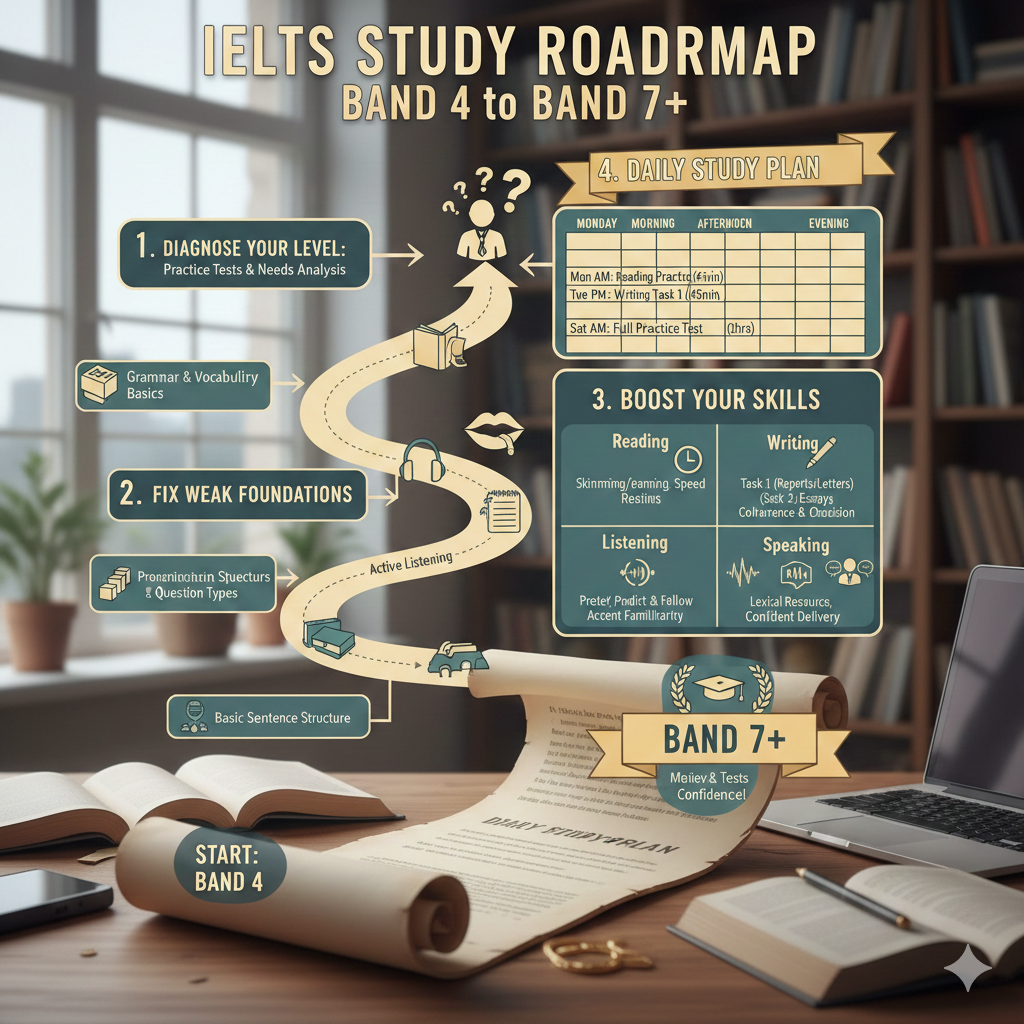
IELTS Listening Preparation Online: A Step By Step Plan
Here is a succinct timeline you can follow for four weeks.
Week 1: Build Foundation
- Learn the format of the test
Practice one mock test daily - Study common accents
- Focus on question prediction
Week 2: Increase Accuracy
- Practice section 4 daily
- Train paraphrasing recognition
Improve spelling and numbers: - Use QuickIELTS analytics to find weak points
Week 3: Speed and Focus
- Do two complete tests per day
- Increase shadow listening
- Practice under strict time control
Week 4: Final Polish
- Take timed tests only
- Do not pause or replay
- Improve your weakest question types
- Review all past errors
This four-week plan is enough for many students to move from a band 6 or 6.5 to 7.5 or even 8.
NUR 590 Week 2 Topics for DQ Tuesday Describe the critical thinking process. What are some barriers to effective critical thinking? How can critical thinking be developed?
Advanced IELTS Tips and Tricks for Listening
For perfection-seeking students, here are a few advanced methods.
1. Train with faster audio
If you can understand fast speech, then normal IELTS audio will be easy. Speed training strengthens your processing ability.
2. Learn Academic Vocabulary
Most of the answers come from academic themes such as environment, health, biology, technology, and finance. Strong vocabulary reduces confusion.
3. Practice While Tired
This might sound weird, but sometimes you will feel tired or stressed during a test. Practice in less-than-ideal conditions primes your brain to focus even in such situations.
4. Develop Split Concentration
You need to listen, read, and write simultaneously. As a way of training, try listening to an audio clip while taking short notes.
5. Review Common Spelling Traps
Many spelling mistakes are made in words like "accommodation", "environment", "committee", or "rhythm". One mistake costs a point.
How to Make the Most of Online Tools
A great online preparation tool saves time, helps you to track your progress, and pushes you towards your target band.
QuickIELTS makes this process simple because it has:
- A rapid test engine
- One click scoring
- Error analysis
- Resource library
- Dashboard tracking
If you combine QuickIELTS with sites like Cambridge English and British Council, you will have complete preparation.
Final Thoughts: Your Path to Band 9 Starts with Smart Listening

Getting a high score in IELTS listening is not about being a native speaker; it's about technique, awareness, and steady practice.
If you follow the IELTS listening tips in this guide and combine them with regular training on QuickIELTS and other trusted resources, you will achieve real results.
You now have:
- IELTS listening tips for band 9
- IELTS tips and tricks for listening
- IELTS listening section 4 tips
- Free online IELTS practice test links
- A full preparation plan
- High quality websites to study from